
Line-Breakers at the Back: Ranking Serie A's Most Progressive Center Backs
A custom metric evaluating defenders who move the game forward through smart carries and incisive passes while penalizing conservative choices and misfires.

Introduction
Progressive, ball-playing center backs are my favorite players to watch not at the expense of defensive solidity, of course, but in today’s game, technical ability on the ball is essential.
You can’t just lump it long and hope for the best, especially against elite, structured sides with physically dominant defenders. What good is a long-ball strategy against the likes of Van Dijk and Konaté (Liverpool), Dias, Gvardiol, Akanji (Man City), Saliba and Gabriel (Arsenal), or Inter’s backline with Bastoni, Acerbi, and Pavard?
Sure, long-ball systems can still work but they demand precision, coordination, and proper technical training. And when it comes to facing top-level opposition, structure and ball retention from the back are non-negotiable.
In this piece, I decided to analyze Serie A’s center backs through the lens of progression, identifying the defenders who help their teams build and advance play with composure and intent. Italian football, after all, has a rich tradition of manipulating pressing structures with clever one-touch combinations and controlled buildup.
I had a few names in mind before running the numbers. Let’s see who stood out.
Methodology: Measuring Progression from the Back
The Progression Score was built to capture how much value center backs add when advancing the ball whether by carrying it forward or finding teammates in space. But not all progressive actions are equal, so the metric accounts for location, intent, and success.
Here’s how it was calculated:
🔍 Filtering the Right Events
We began by filtering StatsBomb's Serie A event data to focus only on players listed as center backs (Left CB, Right CB, or CB) and isolated passes and carries as the relevant progression events.
📈 Scoring the Actions
Each pass or carry was graded based on three factors:
Verticality: Gained ground toward the opponent’s goal (x-axis movement).
Central Threat: Actions played closer to the center of the pitch received bonus value.
Half-Space Bonus: Additional credit was given to actions that ended in the half-spaces (a high-value attacking zone between the wings and center).
Only passes successfully received (via the next event being a ball receipt) were counted, helping penalize failed or intercepted passes.
⚖️ Contextualizing with Possession Share
To ensure fairness across different tactical setups, we adjusted each player’s raw progression score using their team’s average possession share throughout the season. A player from a low-possession team like Monza has fewer chances to build from the back than one from a high-possession side like Inter.
So we:
Calculated each team’s average possession share.
Adjusted the progression scores by dividing them by that possession rate—giving more weight to impactful actions done with fewer touches.
🧪 Final Touch: Per 90 & Normalization
We:
Filtered players with at least 900 minutes played for robustness.
Calculated progression score per 90 minutes.
Normalized the scores from 0 to 1, making them easy to compare.
Results
🔝 Reaction: Bastoni and the Elite Ball-Playing Defenders
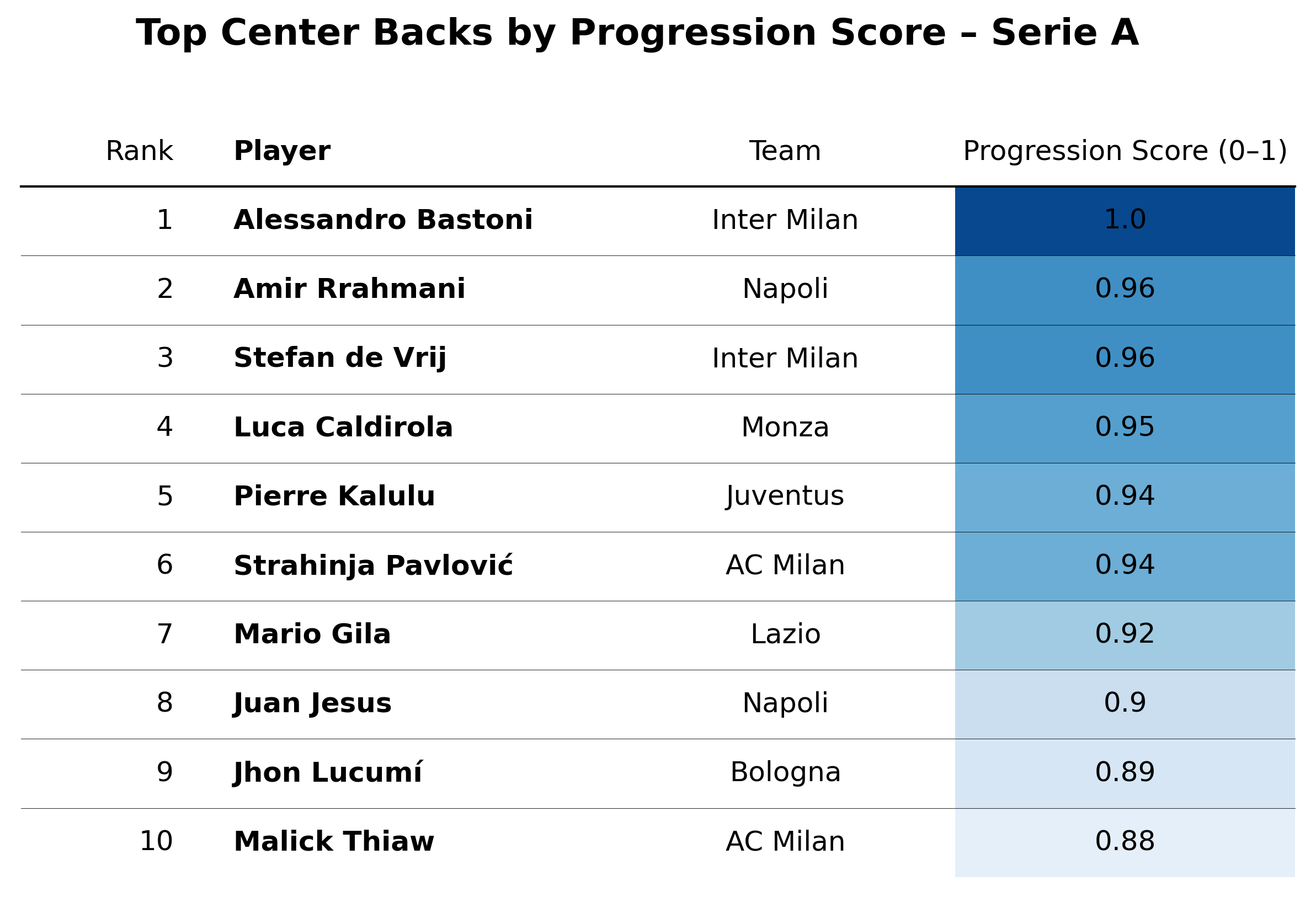
When the results came in, I couldn’t help but smile, Bastoni at the top was exactly what I expected, and I’m proud the model reflected that. What more can I say about him? He’s not just my favorite Inter player but, in my eyes, the gold standard for a modern center back. Calm under pressure, technically gifted, physically strong, and a leader on the pitch. He doesn’t dive into tackles recklessly, yet he’s far from passive. His ability to break lines with precision long balls and resist the press makes him a unique weapon. If you want to stop Bastoni, the only way is to deny him the ball altogether because once he’s in control, there’s no good defensive answer.
Rahmani deserves just as much praise. While others rotated in and out during Napoli’s title-winning season, he was the constant rock in the backline. Strong, balanced, and composed, he was vital both defensively and in buildup. Many talk about Buongiorno as a great signing, but Rahmani was the foundation of Napoli’s success.
De Vrij, despite losing his starting spot, still stands out as one of the most elegant defenders in possession. His composure, long-range passing, and decision-making remain top-tier. While he may lack the physical dominance or defensive aggression of others, his class on the ball is undeniable. He only lost his place to a true warrior in Acerbi, who just narrowly missed the top 10.
Caldirola is a pleasant surprise in this ranking. Once on the radar of bigger teams, he's now a free agent after Monza’s relegation and could be a smart addition for mid-table or struggling Serie A sides. Reliable and progressive, he remains a solid, underrated option.
Kalulu’s move to Juventus broke Milanista hearts and for good reason. Milan lost a valuable, versatile defender who can play both center back and full back, while Juve gained a bargain. His performance in their last head-to-head game said it all. Meanwhile, Milan's attempts to replace him bring us to Pavlović also in the top 10.
Pavlović shares Kalulu’s versatility and composure, capable in a back three, back four, or even at full back. While I think Kalulu is slightly more composed on the ball, Pavlović has integrated well at Milan and shown promising character and adaptability.
Mario Gila at Lazio is quietly making a name for himself. He had a strong individual season and is establishing himself in the backline. Though he can be overzealous in duels, he’s young and has plenty of room to grow especially under a more possession-focused coach like Sarri, should they reunite.
Juan Jesus is a Serie A veteran, the vampire who never leaves. Over 13 years in the league, he’s worn the shirts of top clubs and, even when benched, always delivers when called upon. His technical skills often go unnoticed, but he’s been a key figure in Napoli’s recent title runs.
Lucumí is entering his prime and should probably consider a big move. His vertical passing has been instrumental to Bologna's success, and while his carrying could improve, his assertiveness and ball-playing qualities make him an exciting option for bigger sides.
Finally, Malick Thiaw. He’s a bit of an enigma, physically gifted, good on the ball, and clearly talented, but has struggled for consistent game time. Under Allegri, it feels like it could be make-or-break. He has all the tools to thrive, but needs the right setting to fully unlock them.
🧠 Conclusion: From Above to Within
I remember when people mocked Guardiola for spending a fortune on John Stones, only for him to become pivotal to Manchester City’s evolution. I remember the skepticism around Liverpool splashing cash on Van Dijk, only for him to redefine their defense. I remember De Zerbi’s Sassuolo being criticized by traditionalist Italian coaches for insisting on ball-playing center backs. And I remember Mourinho’s teams struggling against well-organized presses because playing from the back wasn’t a priority.
Moments like a goal kick turning into a scoring chance, or a calmly recycled ball luring a press only to be bypassed with 5–10 crisp passes ending in a top-quality shot, those are the sequences that bring pure joy to modern football lovers.
Who could forget Arteta’s early COVID-era Arsenal lifting the FA Cup thanks in part to buildup from the back? Or Conte’s Inter breaking Barcelona’s high press with sheer structure and confidence, to the admiration of neutrals?
Today, having defenders who can play with the ball isn’t a luxury, it’s a necessity. Of course, it shouldn’t come at the expense of defensive ability, but being progressive on the ball is now central to the role.
This metric not only confirms why elite center backs are in such high demand, but also shines a spotlight on some underrated talents delivering quietly but effectively. And maybe, just maybe, coaches like Guardiola, De Zerbi, or other forward-thinking tacticians might find use in these numbers.
Because in the modern game, progress doesn’t just come from above it begins from within.
Support My Work and Join the Journey
Support the journey and take your first steps into football analytics! Visit my Payhip store for exclusive resources designed to kickstart your path to becoming a top-tier football analyst.
Embrace the process, it’s in the learning journey where your true potential shines. Your support not only helps you grow but also allows me to keep creating valuable content for the community. Together, let’s shape the future of football analytics.
Very interesting!!! Bologna has been famous tha last few years for having exceptionally good progressive defenders. Calafiori, Lucumi and Beukema all fit that prototype of player really well. Read about the man that put it all together!
https://federicotomadin.substack.com/p/giovanni-sartori-the-sporting-director-549
Very interesting the way you use the data!