
Link-Up Value: The Forwards Who Make Their Teams Tick
A custom metric to identify which strikers bring more than just goals by connecting moves and creating value outside the box.

Introduction
Forwards are judged by goals, the end product is what everyone remembers. But the truth is, they don’t always receive the ball in dangerous areas. And that’s when the real strikers stand out: the ones who drop in, link play, and keep their team moving forward.
Personally, I’ve never enjoyed watching strikers who disappear when their team needs them most. As Mourinho once said, there are forwards who are only forwards when they score, and there are forwards who are forwards even when they don’t score. I prefer the second type.
The debate between valuing pure goalscoring vs. link-up play has always felt strange to me. Why not both? Modern strikers are skilled enough to combine finishing with effective involvement in buildup far beyond the “poacher” archetype of previous generations which for some reason people think are better.
In this piece, I’ll be diving into StatsBomb’s Premier League event data for the 2024/25 season to introduce a new metric: Link-Up Value (LUV). The goal is to measure which forwards truly connect their team’s play not just by being the last touch, but by being part of the move itself.
⚙️ Methodology: How Link-Up Value (LUV) Is Calculated
The Link-Up Value Score is designed to measure how effectively a striker connects play outside the box not just by scoring, but by keeping their team’s attacks alive and moving forward. Here’s how it works:
1. 🎯 Focus on Forwards
Only players listed as Center Forward, Left Center Forward, or Right Center Forward are considered. These are the players most responsible for holding the ball up, combining with teammates, and linking attacks.
2. 📍 Trigger: Ball Receipts Outside the Box
The metric begins whenever a forward receives the ball outside the penalty area. This ensures we capture link-up moments, not just finishing actions close to goal.
3. ⏱️ Lookahead Window
From the moment of receipt, we track the next 10 seconds of play. Only actions by the same team in this window are considered, focusing on how the striker helps sustain or progress the attack.
4. 📈 Scoring the Actions
The first meaningful action after the striker’s receipt is scored:
Completed Passes → Rewarded for forward progress and playing centrally. Small credit for safe sideways passes, and penalties for backwards ones.
Carries → Rewarded for driving forward and staying central.
Dribbles → Credit for successful take-ons, small penalty if failed.
Shots → Credit linked to expected goals (xG). If the striker himself shoots, he gets extra credit for high-xG efforts but a penalty if it doesn’t result in a goal.
5. 🔗 Chain Effects
If the striker’s action is positive, we also look at:
Team Shots within the 10-second window → extra credit tied to the xG.
Box Entries → bonus points if the team moves the ball into the penalty area.
6. 🧮 Final Calculations
Each action is clipped between −2 and +2 to keep extremes in check.
Player totals are summed and converted into per 90 minutes values.
To account for different team styles, scores are adjusted by team possession share.
Finally, scores are normalized on a 0–1 scale for easier comparison across players.
Results: Premier League’s Link-Up Leaders
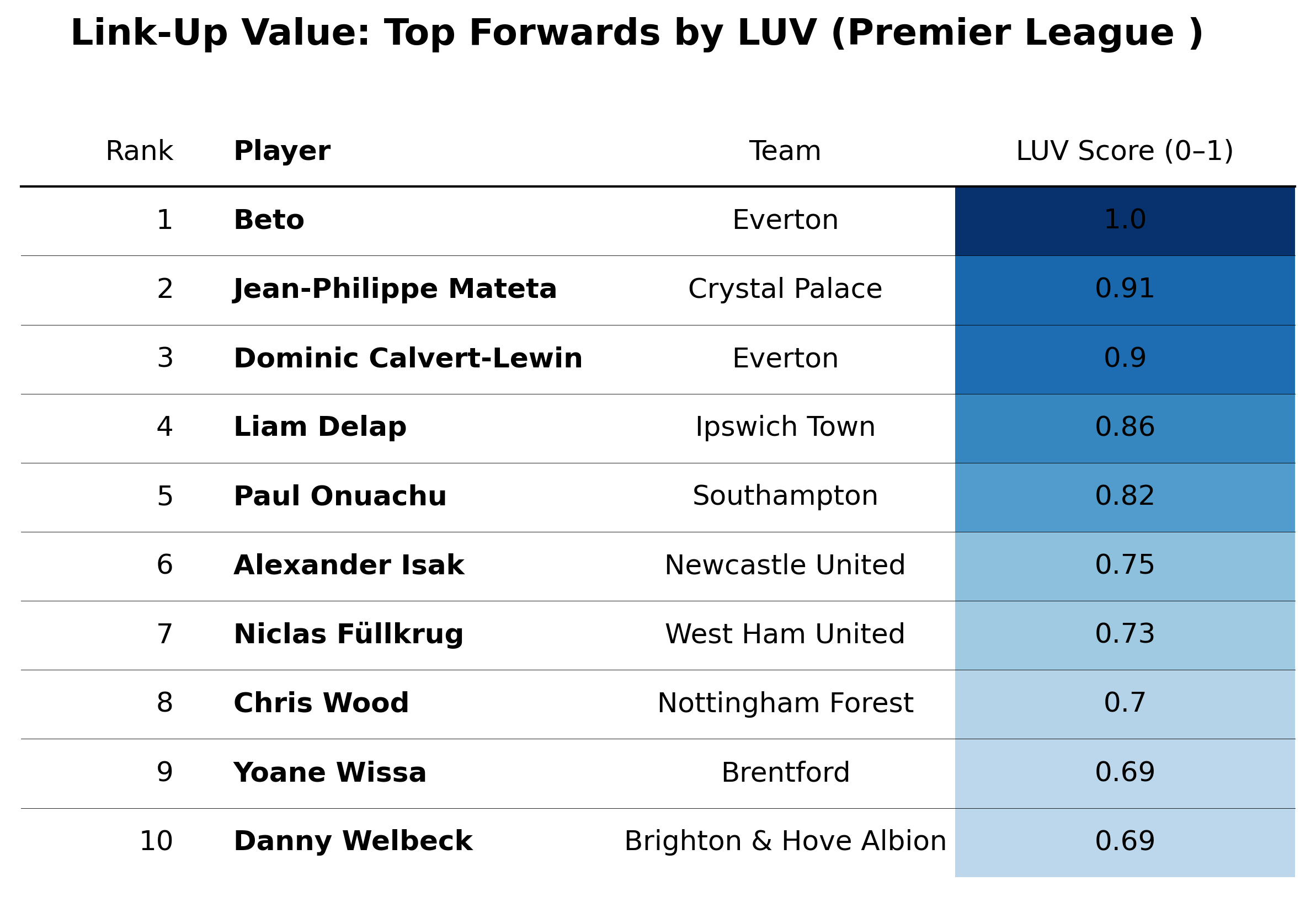
At the top of the list is Beto, whose link-up play and physical dominance were well established long before his Premier League arrival. Now, with Calvert-Lewin (3rd on the list) leaving on a free and joining Leeds, Beto has stepped up as Everton’s main number 9. It’s a role he looks born for. Interestingly, Calvert-Lewin himself is a reminder of how the market has changed five years ago, a free transfer of that profile would have sparked a scramble from top clubs across England.
In second place comes Jean-Philippe Mateta, a striker who embodies Crystal Palace’s direct and efficient style. His FA Cup final involvement in the goal was the perfect example: when Sean Dyche, on commentary, instructed Palace simply playing over the press instead of through it, it was Mateta who made that approach count. For me, he’s a genuine top striker.
Beyond them, the list offers a fascinating mix of profiles:
Delap sneaks into the top 10 thanks to his raw physicality and direct style edging out Nicolas Jackson, who just missed the cut.
Onuachu, now at Trabzonspor, intrigues me as a target striker who might have been underused at Southampton.
Isak continues to shine as the complete modern striker, showing up positively in almost every advanced metric, no wonder he’s so coveted.
Füllkrug, a player I rated highly back in 2023 as a potential Kane successor, has proven his link-up credentials at Dortmund, even helping lead them to a Champions League final.
Chris Wood remains central to Nottingham Forest’s push into Europe, his stature and hold-up play are essential in breaking presses and establishing territory.
Wissa brings a unique blend of strength and pace that has made him a target for several clubs.
And finally, Danny Welbeck rounds out the top 10. The “vampire,” as many affectionately call him, continues to defy age. Written off after leaving Arsenal, he has reinvented himself at Brighton as a reliable and intelligent link-up forward.
Conclusion: Be Involved
A striker should never go missing. At the very least, they should drag defenders out of position, hold the ball up, and give their teammates an outlet when the game gets tough. Forwards who stand passively waiting for service frustrate me, the best strikers are active, mobile, and willing to work for the team.
Harry Kane, for me, set the modern benchmark. His ability to drop deep, link play, and still deliver goals has redefined what the center-forward role can be. In elite football, where margins are slim, a striker who contributes beyond finishing can be the difference whether it’s creating midfield overloads or offering a direct escape route against a press.
The evolution of the striker is fascinating. Those who can both score and link up play give you two positions in one. And as this analysis shows, some forwards in the Premier League are excelling in this dual role, the kind of players who don’t just wait for chances, but actively elevate their team.
Support My Work and Join the Journey
Support the journey and take your first steps into football analytics! Visit my Payhip store for exclusive resources designed to kickstart your path to becoming a top-tier football analyst.
Embrace the process, it’s in the learning journey where your true potential shines. Your support not only helps you grow but also allows me to keep creating valuable content for the community. Together, let’s shape the future of football analytics.
Where did he say this?
"As Mourinho once said, there are forwards who are only forwards when they score, and there are forwards who are forwards even when they don’t score."
You're are analysing a link-up forward and don't score the action of receiving the ball between the 1st and 2nd lines of defense, valuing more on the central channel and by the number of meters of the received passes? Your metric really doesn't capture what a link-up forward is. The link-up forward receives the pass and links-up with the team, he doesn't solve things by himself, that's why carries, dribles and shots aren't the main determinants of a link-up forward. All the forwards on your list aren't link-up forwards. A link-up forward receives the ball between lines, normally progresses via one-twos and makes passes/assists to the opponent area.